Caraga Remains PH’s 2nd Fastest-Growing Region in 2025 with 5.7% Expansion

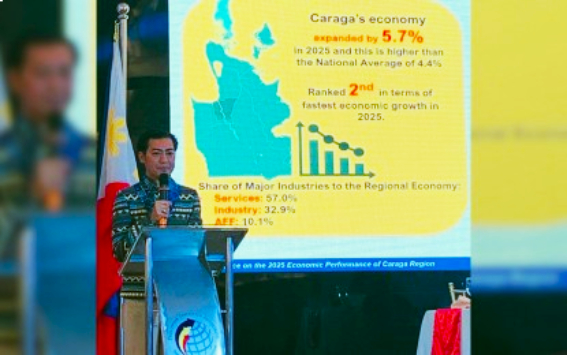
Butuan City – The Caraga Region sustained its strong economic momentum in 2025, posting a 5.7 percent growth rate—well above the national average of 4.4 percent—and ranking as the second fastest-growing economy among the country’s 18 regions, according to the Philippine Statistics Authority (PSA-13).
The region also held the same rank in 2024, when it recorded a higher 6.9 percent growth in its gross regional domestic product (GRDP).
PSA-13 Officer-in-Charge Regional Director Guillermo Lipio Jr. said the services sector remained the main driver of growth, expanding by 7.2 percent and contributing the largest share to the regional economy.
Services accounted for 57 percent of GRDP, valued at PHP218.66 billion, followed by industry at 32.9 percent (PHP126.37 billion) and agriculture, forestry, and fisheries at 10.1 percent (PHP38.69 billion). Growth in the industry sector reached 4.8 percent, while agriculture posted a modest 0.4 percent increase.
“The performance underscores the growing role of the services sector, with industry and agriculture serving as key supporting pillars,” Lipio said during the regional presentation.
Caraga’s per capita GRDP also improved, rising to PHP129,925 in 2025 from PHP124,236 the previous year.
The region ranked just behind Western Visayas, which led all regions with 6.38 percent growth, and ahead of the Negros Island Region, which posted 5.7 percent.
Within the services sector, financial and insurance activities recorded the fastest growth at 24 percent, followed by wholesale and retail trade at 20.5 percent and transportation and storage at 10.7 percent.
In industry, manufacturing led the expansion with a 39.7 percent increase, followed by construction at 29.3 percent and mining at 22.3 percent.
Meanwhile, agriculture saw strong gains in crops, which grew by 53 percent, along with livestock and poultry at 21.6 percent and support activities at 11.7 percent.
On the expenditure side, the fastest growth rates were recorded in valuables (40.14 percent), imports of services (22.13 percent), and imports of goods (16.88 percent).
Per capita household spending also rose to PHP98,053, up 5.6 percent from PHP92,854 in 2024. Household final consumption expenditure remained the largest component of the regional economy, accounting for 75.5 percent of total expenditures.
Gemima Olam of the Department of Economy, Planning, and Development welcomed the results, saying they reflect continued expansion while highlighting areas that require sustained attention.
Officials from government agencies, academe, and the private sector attended the economic briefing.
NPO News Team | Philippine News Agency - PR