DA Opens P99-M Integrated Agri Laboratory to Boost Services for Cordillera Farmers

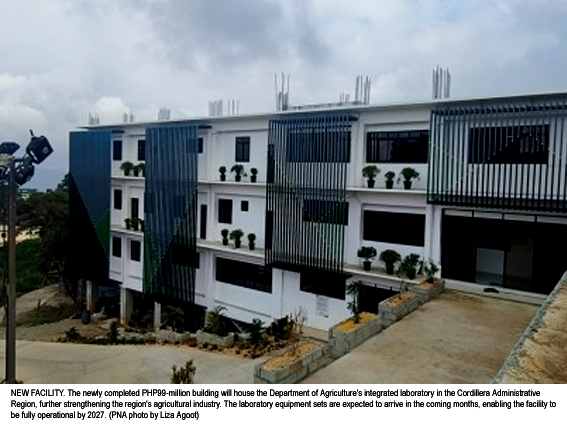
BAGUIO CITY – The Department of Agriculture (DA) has completed a PHP99-million, three-story building that will house an integrated agricultural and health laboratory serving the Cordillera Administrative Region (CAR), aimed at making vital diagnostic and research services more accessible to farmers.
Dr. Ofelia Qarah Pacio, chief of the DA-CAR Integrated Laboratory Division, said the new facility consolidates four laboratories under one roof to streamline services for clients, particularly farmers.
“There will be four laboratories that will operate here, all together in one place for easier access, especially the farmers who are the primary clients,” Pacio said in an interview Thursday.
The laboratories include the Regional Soils Laboratory, the Crop Protection Center, the Animal Disease and Diagnostic Laboratory, and the Feed Chemical Analysis Laboratory.
Located at the Baguio Animal Breeding and Research Center in Santo Tomas, the facility will play a key role in completing soil analysis and developing fertility maps to guide farmers on proper fertilizer use and nutrient management.
Previously, these laboratories operated in separate locations, making it difficult for farmers to access services. Without proper soil testing, many farmers rely on guesswork in applying soil amendments, increasing production costs without scientific basis.
Beyond soil diagnostics, the Crop Protection Center will produce natural and environmentally friendly biocontrol agents to reduce dependence on chemical pesticides.
The Feed Chemical Analysis Laboratory, meanwhile, will assess the nutritional composition of animal feeds, including those derived from high-value crops, to enhance product quality and competitiveness.
“We intend to expand the crops we analyze to allow us to further improve the quality of produce, especially the high-value crops that we need to be competing in the market,” Pacio said.
The Animal Disease and Diagnostic Laboratory will address serious threats such as African swine fever and avian influenza, which have caused significant disruptions in agricultural production.
Laboratory services will be offered free of charge to farmers, while researchers will pay minimal fees, with discounts available for students. Tests related to diseases with major economic and public health implications will also be provided at no cost.
Equipment installation is expected to begin this month and continue through the year, with additional funding already approved for 2026.
In a separate interview, Dr. Maribel Mananguit, head of the Soils Laboratory, said farmers in remote areas may submit testing requests through their respective local government units, which will also relay results, interpretations, and recommendations.
“We ask the farmers to utilize the facility. This is for them, which is the government’s way of helping improve the industry so that they can continue to help feed the people,” she said.
NPO News Team | PNA-PR